Patrick Kingsley reporting for The Guardian in Borno state, Nigeria. Hunger follows displaced people around north-east Nigeria, as Boko Haram and climate change drive millions from their homes.
““The narrative of this deepening humanitarian crisis in north-east Nigeria has been largely overlooked by the media, whose focus remains on the kidnapping of roughly 300 Chibok school girls,” says Orla Fagan, a spokesperson for UN’s office for coordination of humanitarian affairs.”
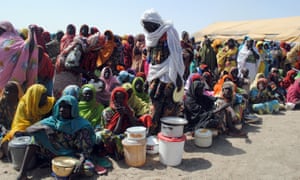
Women and children queue outside a Unicef nutrition clinic in a makeshift settlement in Muna, Maiduguri, which is home to thousands of IDPs. Photograph: Stefan Heunis/AFP/Getty
As Ali Kawu eases his handcart to a halt on a recent morning in north-east Nigeria, it is the first time he has dared to stop walking in more than 24 hours.
A day earlier, at 8am, Boko Haram militants raided his village. Kawu, 25, escaped with what he could – his wife, their three children, and kindling for a fire. They left behind their papers, six sacks of beans, up to 15 dead neighbours, and 10 kidnapped villagers. Then they walked all day and all night.
Ali Kawu, 25, fled to the town on Monguno after being attacked by Boko Haram. The number of displaced people in this small town is comparable to the number who left north Africa for Europe so far this year. Photograph: Patrick Kingsley for the Guardian
“Every minute I would look back to see if they were following us,” Kawu says, shortly after reaching the safety of Monguno, a town recaptured from Boko Haram last year. “Walking forward, looking back, walking forward, looking back. I thought it was the end of my life.”
But safety doesn’t mean comfort. Kawu is just the latest of approximately 140,000 displaced people sheltering in this remote town of 60,000 people. North-east Nigeria has been hit by a displacement crisis that dwarfs any migration flows seen in Europe in recent years.
Since the Boko Haram insurgency began, more people have migrated to Monguno alone than left all of north Africa for Europe in the first nine months of this year.
One upshot is a food crisis that the UN warns might see hundreds of thousands die from famine next year.
About 40% more people have been displaced throughout Borno state (1.4 million) than reached Europe by boat in 2015 (1 million). Across the region, the war against Boko Haram has forced more people from their homes – 2.6 million – than there are Syrians in Turkey, the country that hosts more refugees than any other.
The comparisons mirror a wider trend across Africa. Of the world’s 17 million displaced Africans, 93.7% remain inside the continent, and just 3.3% have reached Europe, according to UN data supplied privately to the Guardian.
“No matter how many problems Europeans have, it’s nothing like this,” summarises Modu Amsami, the informal leader of Monguno’s nine camps for internally displaced people (IDP), as he strolls past Kawu’s newly erected hut. “Please, I’m appealing to Europeans to forget their minor problems. Let them come here and face our major problems.”
For 18 months, Monguno endured its migration crisis largely alone. Amsami is an IDP but decided to run Monguno’s nine camps himself in the absence of any government officials. It was not until this June, a year and a half after the Nigerian army retook the town from Boko Haram, that aid groups and civil servants felt safe to return.
“We were shaken by what we saw,” says Mathieu Kinde, an aid worker with Alima, a medical NGO that was the first to arrive. Many people were starving, having been cut off from their farmland. There was a polio outbreak – Nigeria’s first case in two years. Just one government doctor was left in the town.
To this day, the townspeople cannot farm their fields – Boko Haram remains too close to the town’s perimeter. Aid convoys from Maiduguri, the state capital, risk ambush. Most food can arrive only by helicopter, which is how the Guardian reached the town. The number of people in a famine-like state has been slightly reduced, but every week Alima treats up to 200 new cases of malnutrition. “The situation remains alarming,” says Kinde.
About 68 miles (110km) to the south, Maiduguri seems calmer. It remains under curfew but the roads into the city are largely secure, the streets are clean and its nightlife is reportedly experiencing a tentative revival. But if you know where to look, it is a city under extreme pressure.
More than 600,000 IDPs have migrated to this city of just 1.1 million during peacetime over the past three years, according to the International Organisation for Migration (IOM). About a quarter have been put up in half-built schools, or in housing projects intended for teachers and civil servants. The rest have been taken in by friends and relatives.
The government in Maiduguri has installed 13,000 IDPs in a housing estate originally meant for civil servants. Photograph: Patrick Kingsley for the Guardian
“It’s an amazing story,” says Toby Lanzer, the UN’s assistant secretary general for the Sahel and the Lake Chad region. According to Lanzer, the local community has in effect said: “We built that as a school, but you [IDPs can] have it. And we built that as a new neighbourhood, but we will put you lot in it. How’s that for generosity, Europe?”
But that generosity has come at a price, says the governor of Borno state, the province where the majority of the fighting and displacement has taken place. Unemployment in Maiduguri has exceeded 50% since the start of the crisis, says the governor, Kashim Shettima, while more beggars gather at the major road junctions because the IDPs have few means of alternative income.
“Health facilities are at breaking point,” he says. “All resources have become overstretched. We ask all people of conscience to help.”
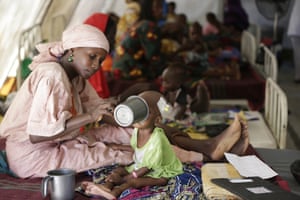
Across the region, about 65,000 people are suffering from famine-like conditions. Inside a makeshift clinic run by Médecins Sans Frontières in a Maiduguri suburb, you can find some of the most dire cases. On bed after bed, about 100 skeletal babies and toddlers stare vacantly into space. Many have plastic nodules stuck to their skull, to allow the nurses to attach them to a drip. Many children are so thin their scalp is the only place a visible vein can be found.
“Getting food became so difficult after my husband was killed [by Boko Haram],” says one mother, whose malnourished three-year-old lies motionless on the bed beside her. “I would beg every day but I wouldn’t get more than 100 naira [25p] a day. And that’s how he got hungry.”
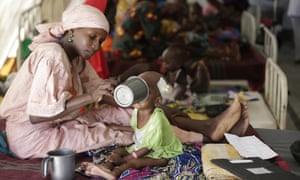
A mother feeds her malnourished child at a nutrition clinic run by Médicins Sans Frontières in Maiduguri. Thousands of children have died of starvation and disease in Boko Haram-ravaged north-eastern Nigeria. Photograph: Sunday Alamba/AP
The international community has largely failed to help: UN funding is still 61% ($297m) short of its target. Local residents have stepped in where they can. Babakara al-Kali, a Maiduguri businessman, has given a plot of land to about 3,000 IDPs – forgoing the 10m naira (£25,000) he previously charged construction workers and mechanics to rent it every year. “If you help someone, God will help you,” Kali says. “So I decided to help them.”
Still, the conditions inside this makeshift camp are abject. Streams of slurry trickle through the site. A family mourns a child who died yesterday of hunger. Two elderly men have become blind in recent days and the camp’s elders blame the lack of food. Some residents spend their mornings collecting spilt grain at the local market; in the afternoons, they sift through them piece by piece, sorting the edible grains from the rotten ones.
“We have lost count of the number of people killed by hunger,” says Bulama Modusalim, the camp’s informal leader.
Aside from their physical problems, many of the IDPs across the region are suffering from psychological trauma. Almost every interviewee tells a story of being woken at dawn by gunfire, of emerging from their huts to find Boko Haram fighters killing their neighbours or kidnapping their relatives.
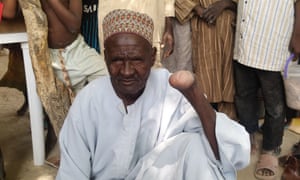
Ali Falfami, 73, had his hand removed after being shot by Boko Haram fighters. Photograph: Patrick Kingsley for the Guardian
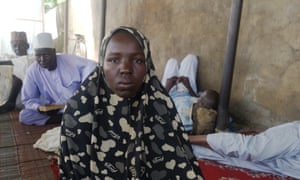
Ali Falfami, 73, has a missing hand; it was amputated after being shot by Boko Haram. Karu Modu, 28, has a missing son – he was shot by the militants – and a missing husband: they slit his throat. Modu survived because she agreed to watch their murder. “They forced me to watch them die so that I would not be slaughtered,” she says, before breaking down in tears.
Modu was then kidnapped and held for nearly two years. After escaping with a group of fellow captives, six of their children died of thirst as they trekked to the safety of Maiduguri. On arrival, they were initially ostracised. People feared the women had become indoctrinated during their time with the extremists, and were wary of talking to or even sitting with the returnees.
Karu Modu, 28, was kidnapped and held by Boko Haram for two years. Photograph: Patrick Kingsley for the Guardian
These are not isolated experiences. The #BringBackOurGirls campaign has focused on the group of schoolgirls kidnapped from Chibok in 2014 – but away from the media spotlight, thousands of others are believed to have also been abducted in other incidents. At one point, Boko Haram controlled an area the size of Belgium and killed an estimated 20,000 people. Now the group is in retreat, but millions more still face food shortages.
“The narrative of this deepening humanitarian crisis in north-east Nigeria has been largely overlooked by the media, whose focus remains on the kidnapping of roughly 300 Chibok school girls,” says Orla Fagan, a spokesperson for UN’s office for coordination of humanitarian affairs.
“Each one of the girls who remains captivity is a minuscule representation of the millions of Nigerians who now face starvation across the north-east as a result of Boko Haram violence. They are some of the poorest, most vulnerable members of society, who also continue to struggle for their basic needs to survive each and every day.”
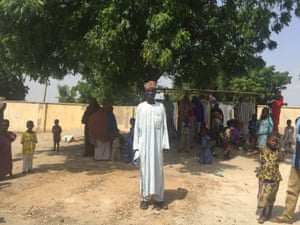
Many of them are being encouraged to return home where they face uncertain futures. The Nigerian army has retaken several key towns from the insurgents, and the government wants their former residents to go back to what they say are now safe areas. But the reality is more complex: the roads in and out are often still contested, as are the fields surrounding the towns. Many buildings lie in ruins and, as a result, returnees are often forced to live in IDP camps even after they have nominally reached their hometown.
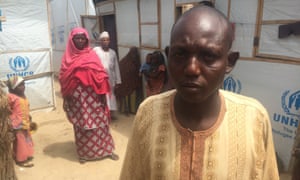
Bulama Modusalim is the informal leader of a makeshift camp for IDPs displaced by the Boko Haram insurgency in north-east Nigeria. Photograph: Patrick Kingsley for the Guardian
Bulama Modusalim, the leader of the informal camp in Maiduguri, took a group of villagers back to Konduga in August, after the government assured them it was safe. “But when we went back we found that Boko Haram was still [in the surrounding area],” says Modusalim. “We went back and we found our houses were destroyed. We couldn’t go further than 1km from the town, so we couldn’t farm.”
Eventually, the situation became so desperate that they went back to Maiduguri, despite the poverty they knew they would face there. In a choice between war and starvation, they would rather risk the latter.
Amid all this misery, Boko Haram is the most obvious explanation for what has gone wrong. Nearly everyone is running from the jihadis who still control significant parts of the Lake Chad basin. But what led to the group’s rise in the first place? Local leaders say the group was initially able to present its fighters as victims of police brutality – and more generally positioned Boko Haram as a radical alternative to the high levels of regional poverty and unemployment.
But according to several interviewees, including the local governor, this social alienation was partly fuelled by rapid climate change. North-east Nigeria borders Lake Chad, a vast inland lake that supplies water to about 70 million people in four countries – Nigeria, Chad, Cameroon and Niger. But since the 1970s, it has shrunk by 90% – from 25,000km2 to less than 2,500km2. And those who live near its former shores say this shrinkage is one indirect cause of violence in the region, and the subsequent displacement.
Modu Amsami, the IDP who runs the nine camps in Monguno, comes from the village of Gumnari, which was once just 2km from the lake. Now it’s 18km away.
“In the 70s, you could put this tree in the lake,” Amsami says, pointing at a nearby tree, “and you wouldn’t even see it. Now if I walked in there, the water wouldn’t even reach my chest.”
As a child, Amsami’s father would tie him to a tree to stop him entering the lake and being eaten by crocodiles. Today there would be no need. The water is nowhere in sight and it’s difficult to even see a crocodile.
Modu Amsami stands next to a tree that he says would once have been submerged by Lake Chad. Now the waters would not reach his shoulders, he says. Photograph: Patrick Kingsley for the Guardian
All this has led to unemployment for thousands of fishermen and farmers – including several people from Amsami’s family. He reckons this worsened living conditions, created a wave of unemployed and disaffected youth – and so helped fuel the anger and resentment that created Boko Haram. “If the Lake Chad water was normal,” says Amsami, “all these problems [with Boko Haram] would be eliminated economically, because nobody would have time to do all these things.”
According to the IOM, few of the roughly 35,000 Nigerians who have in Europe this year are fleeing from the insurgency in the north-east. But the west would be wise to take the Lake Chad crisis seriously, lest the millions seeking sanctuary in the region decide to move towards Europe. Lanzer says he is “willing to bet a month’s salary that the proportion of people who will arrive in Europe from Nigeria, Chad, Cameroon and via Niger will grow substantially”.
Shettima speaks in even starker terms: “As long as the underlying problems that precipitate the crisis are not met, then there is a risk that more Nigerians will try to go to Europe.
“At the moment, most of them are economic migrants, but if this madness is not solved, believe me you will see a mass of humanity trying to get to Europe via the Mediterranean.”
More than 120,000 people, most of them children, are at risk of starving to death next year in areas of Nigeria affected by the Boko Haram insurgency, the United Nations is warning.
Intense fighting in parts of Nigeria, Chad, Niger and Cameroon has left more than 2 million people displaced, farmers unable to harvest their crops and aid groups unable to reach isolated communities. One small state in Nigeria has more displaced people than the entire refugee influx that arrived in Europe last year.
A Guardian correspondent saw dozens of skeletal babies at a makeshift camp in the regional centre Maiduguri. Many had plastic nodules stuck to their skull, to allow the nurses to attach them to a drip. Many children are so thin their scalp is the only place where a visible vein can be found.
And yet despite these appalling scenes, Maiduguri is among the best served places in a region the size of Belgium. Much of the area is still insecure because of the war with Boko Haram, and countless thousands have not made it to population centres where some degree of care is available.
Orla Fagan, a Nigeria-based spokesperson for UN’s Office for the Coordination of Humanitarian Affairs (UNOCHA), said: “You’re looking at over 120,000 deaths next year if you can’t get aid to them – and they’re mostly children. If we can’t reach people with food and nutritional assistance there will be deaths.”
Kevin Watkins, chief executive of Save the Children, said following a recent trip that the entire region was “teetering on the brink”.
“We know in areas that we can get to that there are severe and acute malnutrition rates,” Watkins said. But beyond that, he said, “there are pockets that are probably far worse than the areas that we are dealing with. And the estimates are that there are probably 400,000 children who are in a condition of very severe malnutrition.”
He said unless emergency measures were taken, 200 children would die every day over the next year. A crucial meeting is planned for Abuja next Friday (2 December) at which aid agencies will try to agree a plan of action.
“And yet despite this background, this is a completely hidden emergency,” Watkins said. “The international community hasn’t responded on any scale at all.”
Kashim Shettima, the governor of Borno, the Nigerian state that has borne the brunt of the insurgency, said the farming that usually sustains locals had collapsed. “Most of our communities have not been able to till their soils for the past four years,” Shettima told the Guardian. “It’s just unimaginable; 80% of the people [in Borno] were denied access to their farms by Boko Haram.”
As a result, at least 55,000 people in north-east Nigeria are in a famine-like condition, Fagan says. According to UN classifications, these people are at the fifth and worst stage of food insecurity.
A further 1.8 million people are at the fourth phase, which is defined as a crisis, while 6.1 million are at the third phase, which constitutes an emergency. UNOCHA expects both figures to rise to 2 million and 8.3 million respectively within the next year.
A doctor checks a malnourished child at a camp in Yola. Photograph: Sunday Alamba/AP
“It’s the biggest crisis on the continent and it’s being ignored,” said Fagan. “What’s happening in Aleppo is horrendous, but it’s equally bad in north-east Nigeria – it’s just a different context.”
Widespread unemployment among displaced people has led to starvation even in places with access to aid.
In Maiduguri, which has been overwhelmed by more than 600,000 displaced people, the Guardian visited malnutrition clinics run by Médecins Sans Frontières. Most patients were the children of unemployed displaced people who had been unable to provide them with enough food.
At a nearby camp for 3,000 displaced people, its leader, Bulama Modusalim, said he had lost count of the number of residents who had died of starvation. “Hunger is killing us,” he said, holding up a dangerously thin toddler. “People are dying of hunger every day.”
The child’s mother, Hauwa Nana, 35, said one of her five children had starved to death since they fled to Maiduguri and she feared her toddler would be next. “I can only feed them once a day,” she said.
In Monguno, an isolated town accessible to journalists only by helicopter, aid groups said the situation was just as dire.
“The people here totally depend on aid,” said Mathieu Kinde, project manager for Alima, the first non-governmental organisation to reach the town after it was freed from Boko Haram control. “The host community can’t farm their land because if they go, they sometimes get killed.”
A mother feeds her malnourished child at clinic run by Médecins Sans Frontières in Maiduguri. Photograph: Sunday Alamba/AP
Officials and aid workers warn that if the situation continues it could foment extremism in the area and migration flows farther afield. “A hungry young man is easily susceptible to the manias of religious demagogues like [Boko Haram founder] Mohammed Yusuf and [leader of the insurgents] Abubakar Shekau,” said Shettima.
The insurgency has created huge migration flows within Nigeria and Toby Lanzer, the UN assistant secretary general and regional humanitarian coordinator for the Sahel, warned that many of displaced people may eventually try to reach Europe.
“You’ve been totally focused on people arriving [in Europe] because of problems in Syria and Afghanistan,” he said. “But over the course of the next five years, I can predict – and I’d be willing to bet a month’s salary – that the proportion of people who will arrive in Europe from Nigeria, Chad, Cameroon and via Niger will grow substantially.”
Radio interview on the humanitarian crisis in Nigeria’s north-east.
A “forgotten crisis” is taking place in north-eastern Nigeria which the UN humanitarian affairs office (OCHA) warns could be the worst on the African continent. Seven years of insecurity sparked by the terrorist group Boko Haram has affected up to 15 million people in four states, leading to mass displacement. It has also caused a major food shortage as agricultural production has stalled. As a result, some 400,000 children face starvation. Dianne Penn asked OCHA Public Information Officer Órla Fagan about the extent of the crisis.
Shovels are almost as valuable a commodity as food in Nigeria’s north-east these days, because with a shovel you can bury the dead. This is the reality for hundreds and thousands of people fleeing from Boko Haram violence and suffering the effects of mass displacement. Such is the ensuing humanitarian situation that ordinary citizens are unable to recover from treatable diseases such as malaria because of their weakened nutritional status.
Farmers in the north-east haven’t returned to the land for three years in a row because they fear either attack from Boko Haram or the unexploded devices and land minutes
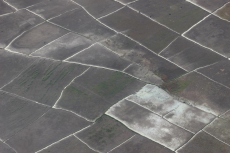
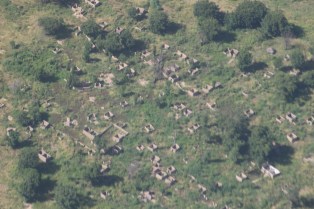
Fallow, fertile land on the way from Maiduguri to Monguno in north-east Nigeria. Photo: Orla Fagan
and land mines planted in place of crops across their farms. The result is food shortages across an area that was the bread basket of Nigeria as fertile land lies fallow.
I travelled by helicopter with the United Nations Humanitarian Air Service (UNHAS) over towns and villages for kilometres on end – all razed to the ground by Boko Haram violence.
Houses and premises are shells – empty, with the roofs of buildings gone and some of the towns going back to the jungle with rapid growth after the rainy season. Burnt out cars and trucks are randomly scattered as they were abandoned when set on fire. In Bama town, two burnt out cars and a truck remain on the courtyard of a petrol station – an apocalyptic scene more reminiscent of a Mad Max movie. You half expect to see Bruce Willis coming out of the jungle with a blackened face and an AK47 with a shoulder strap of bullets slung over his shoulder.
I was back in the helicopter a few weeks ago, travelling to Monguno, Banki and Gwoza on different days. All these areas have become newly accessible to the humanitarian community. I was travelling with Kevin Sieff a journalist with the Washington Post and Jane Hahn a freelance talented photographer – both were deployed to cover the unfolding humanitarian crisis. They had visited Gwoza a year previously, just after the Nigerian Armed Forces pushed out Boko Haram and they wanted to revisit to see what progress was made and also to see some of the lesser-reported areas.
We travelled to Banki on Wednesday 28 September after a 45-minute helicopter trip. The Nigerian Armed Forces controls the town and its officers are understandably paranoid about the possibility of Boko Haram attacks. Citizens are not free to move beyond the perimeter of the town for fear they will share their miserly food allowances with the rebels. Some believe there is a strategy to starve the rebels, but if that is so, then it is also affecting thousands of innocent people left without insufficient food on a daily basis.
There is not much traffic in Banki – the roads around it are too dangerous for humanitarian convoys to come from nearby Maidiguri, the capital of Borno state. The World Food Programme bring in food from neighbouring Cameroon. The first food convoy arrived in July and delivery is sporadic and dependent on road conditions and security.
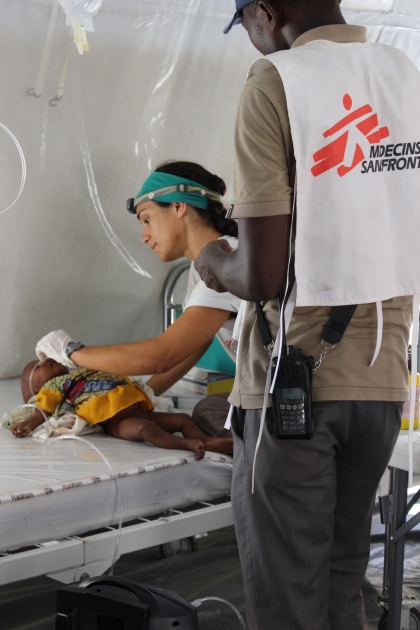
Even the health clinic is run with personnel who come in from Cameroon and is open just a few days each week. Hundreds of people queued outside in the heat of the sun waiting as the nurse performed triage, making decision after decision on which patients needed immediate treatment and who could be treated for minor ailments or left for another day to see the medics.
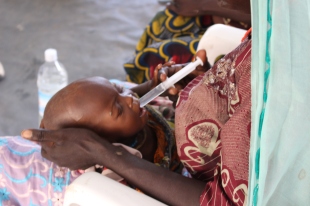
I sat by in the medical tent and watched Kevin interview a few women with clearly malnourished babies, as they fed them with a mixture of water and sugar from syringes, in between feeds – these were severely acute malnourished children who would die without intervention. On a bed was a woman rolling around in pain, occasionally vomiting into a bucket. On another bed a young medic attended to a baby, as her mother sat on a chair watching in bewilderment. The mother, Adama Adam is just 15 years old and already married two years to a 22 year-old man. Fana, her daughter is six months old and weighs just 5 kg. Fana is Adama’s only child. Far too many young girls who should be going to school are married as children themselves and whipped out of school – Adama was just 13 years old when she married. Some men in this bigamist society are fathering scores of children with no thought, awareness , or questioning on whether there is enough land to support this massively increasing population.
Back in Banki, the afternoon heat intensified in the medical tent as the doctor brought in a portable oxygen tank for Fana to assist her breathing. She was hopeful that the baby would make it when her organs showed signs of recovery and Fana peed on the bed. The oxygen tank battery had run out and the doctor gently picked up the baby and with great care moved her to the car where she could recharge the battery. A while later the medic came back into the tent and I asked how the baby was doing, the doctor responded that she was hopeful of a recovery. In order to get Fana to a better-equipped hospital for treatment, they needed a military escort for the ambulance to protect them from Boko Haram attacks. With no reason given, the military refused the escort.
After some time, we proceeded to an orphanage to see the living conditions of the children and a compound full of women, who claimed their husbands’ were abducted; they were possibly Boko Haram widows.
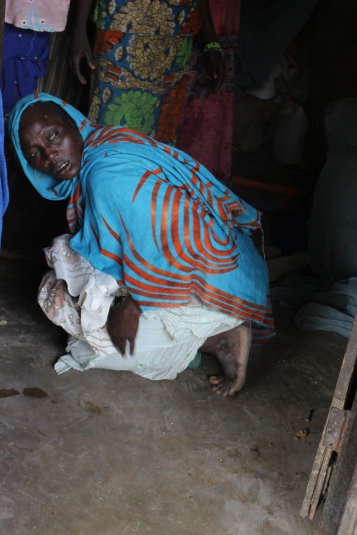
Kevin, Jane and myself were returning to the clinic along the sandy streets when Jane recognized Adama as she walked alongside her sister-in-law who was carrying the remains of Fana, her tiny body still wrapped in the bundle of cloths. Adama walked alongside her husband’s sister, arms hanging by her side, as if, without a child to carry, she didn’t know what to do with them. Tears poured down her face. Fana’s death was caused by malaria but her weakened nutritional status prevented her ability to fight the disease and like so many weakened children, she just didn’t have the strength in the end. Not having access to adequate medical facilities also didn’t enhance Fana’s chances of survival.
Jane, with her journalist instinct used body language and hand signals to ask if it was okay to photograph the two women as they walked back to the house where the family had taken refuge. We followed them into the compound as other family members and people living there gathered to see what had happened. Adama’s husband leaned against the wall, watching, not knowing what to do.
Adama and some family members went indoors as we looked on from the outside. Adama’s sister-in-law knelt on the floor with Fana still in her arms, while a male relative took the baby. Adama, overcome with grief, passed out as the room became crowded with people who came to see what was happening and offer sympathy.
In this culture, funerals are the business of men. Women have nothing to do with the burial. The imam (holy man) came along and with a hand-made hatchet went to the corner of the compound and began digging. He then broke some sticks and placed them across the small hole he had dug. He gently placed the body on the sticks and began washing Fana’s body. The body is washed over the freshly dug hole incase an infectious disease caused the death, so the water used to cleanse the body is absorbed in the hole and not a danger to others in the compound.
A rag was then brought out and the baby’s body wrapped in the material and tied in several places. Fana was then placed on a board and carried to the front of the compound where the men prayed over the body. A wheelbarrow was brought out and the body placed in the barrow as the men in the family went to the army commander to seek permission to bury Fana on the edge of the forest.
I returned to the helicopter pad, to wait and reflect on the afternoon’s events as Jane and Kevin followed the funeral and see Fana’s burial. I felt depressed, deflated and just really helpless. Kevin and Jane were stopped at the edge of the town because in Banki there is an invisible line – on one side the Nigerian military are in control and on the other side it is Boko Haram territory.
September 28 was an upsetting afternoon, not least for Adama and Fana’s family. We were witnesses to something that’s happening day in, day out for many families in Nigeria’s north-east.
Nigeria is considered a wealthy country, but there are millions who live below the poverty line, and in conditions that are incongruous to what should be happening in the 21st Century. These crushing levels poverty with zero quality of life, where children die unnecessarily is just fodder for Boko Haram recruitment.
Innocent people are suffering. The international community is reluctant to contribute to the unfolding humanitarian situation because they believe, and probably rightly so, there is sufficient wealth in this oil rich country.
In the meantime, scores of children and vulnerable people die each day, waiting for assistance that may never come. There are too many demands, with too many crises around the world, from Syria, to Yemen to Lybia, to the Central African Republic with billions of dollars required to assist the most vulnerable citizens of the world. But if we don’t provide the most basics, including food, health and clean water, then it will come back and bite us in the ass. Nigerians striving for a better life, will march towards Europe in their droves to escape the grinding poverty and then maybe, just maybe people will then take notice and do something to address the growing humanitarian needs developing in Nigeria.
I was reminded of just what Nigeria is like when I visited the embassy in Dublin’s leafy upmarket Leeson Place in late June. The visa application office is in the basement of this beautiful old building and it has its own entrance ensuring Joe or Josephine Public is kept far from the embassy offices.
If you’ve ever tried for a Nigerian visa, then you’ll know just how frustrating and protracted it can be. The first time I went to Nigeria I was travelling from Liberia while working for an NGO and it took me five trips before I could gain entry to the embassy. On my fifth attempt, I managed to get my foot inside the door and once achieve, I refused to leave. And that was just to get the application form.
Most of the Nigerians who were queuing in Dublin had Irish passports and required a visa to go back ‘home’. On my first two visits I came well prepared with a book but so swift was my visit I over-paid the parking metre outside. On my third visit Sod’s Law kicked in – I forgot the book and spent my time feeding the metre as I waited for the diplomatic visa to be processed and issued.
On that last visit for the visa, I ended up waiting so long I needed the bathroom. To my surprise, (okay I’m being facetious), the toilets were actually located outside the building; something I don’t imagine exists anywhere else in Dublin in the 21st Century. The inside of the visa application office was reminiscent of a dole office anywhere in Ireland 30 years ago, before the Department of Social Welfare decided they needed to smarten up and pretend to show a little respect for its clients. The carpet tiles were curling at the edges for the want of a cleaning and the walls hadn’t seen a lick of paint for many, many years. There were notices posted everywhere warning that verbal or physical violence would not be tolerated. Notices also threatened that if you even stopped your car outside the embassy gates for just one minute, you may forget about receiving any service. The Nigerians themselves were true to form and vocal about the treatment of ordinary citizen by their government. One Nigerian man commented that he had lived in Eastern Europe where government officials also “sat upstairs (referring to the embassy offices) scratching their arse.” His words, not mine. Another woman told us she was at the embassy every day at 9 a.m. for one week and came prepared with her lunch box. I have to say – there were more than a few chuckles that day.
Nigeria was just a wee culture shock from my previous posting in the hustle and bustle of Bangkok, with its shiny towers, good public transport and general easy lifestyle. While the city of Abuja, the federal capital of Nigeria, is in the heart of Africa, it’s quite unlike any other African city I know (outside most of South Africa).
Renting in the federal capital, Abuja
Abuja was created just 40 years ago to gather the country’s civil servants in one spot. A planned city with huge boulevards and motorways, Abuja is like many cities in West Africa, full of (thankfully) Lebanese restaurants and supermarkets and the bonus of it all, some South African supermarkets. The city empties at weekends as most Nigerian civil servants travel back to their villages and towns after the Muslim Friday prayers. This sprawling city has a shortage of accommodation so rent prices are equivalent to the astronomical rents paid in New York or Geneva. Abuja is also where the UN agencies have their country offices and where I’m based for the next few months.
Accommodation is something else and like Dublin there is a shortage of properties to rent. There are an awful lot of very wealthy property owners who exploit the ex-pat community and civil servants who frequently travel to the city. The first apartment myself and another newly arrived colleague went to look at was dingy beyond belief. You could hardly see the hand in front of your face it was so dark and the ceiling was particularly low – the one-bedroomed apartment was renting for US$1,500 per month. It was such a depressing environment I would have ended up on Prozac within a week, if I had chosen to live there. We ended up in a ‘super luxury apartment’ paying half of my salary in rent. To add insult to injury there is a further charge for laundry, with no washing machine in the apartment. Super luxury the apartment ain’t, but what is luxurious are the number of Mercs and Lexus cars parked outside each day. There seems to have been some very big party (possibly a wedding) at the complex and a 600SL (but what would I know about cars?), parked outside for a few days with the number plate ‘Emir of Zunu’.
Extreme sports
The one positive aspect of the accommodation is that it is within walking distance of the office and the footpaths are more than decent, ensuring walking is not an extreme sport as it can be in many other cities across Africa. I wouldn’t feel safe enough to walk the 3.2 kilometres home alone and do so only when I have company. Walking back to the accommodation in deep conversation one day there was beeping behind us and as we turned around to see a car travelling at about 20 kph up the footpath we had to scramble to the grassy bank to avoid being run over.
I hate assuming stereotypes, but patience isn’t a strong point for most Nigerians. Sitting with the work driver one day and waiting for the solar powered traffic light to turn green, there was a horn honking behind the first car to make the right turn at the lights. When the driver, respecting the rules of the road and the pedestrian crossing didn’t move, the honking-horn driver mounts the footpath and bypasses the cars waiting at the lights to turn right.
Transport around Abuja is reasonably cheap but like everywhere else cars are held together with pieces of string and rubber bands. They frequently break down at the side of the road, or sometimes even in the middle of the road, where they can be abandoned.
I’m still in the process of trying to find another Issac, my lovely taxi driver from Nairobi and so far I’m not having much luck – but I will continue to try. The office drivers are available for a few months to bring us in and out of work, but there’s the supermarket shopping at the weekends and the trips to Blu Cabana, a rather nice place so chill out of a Sunday afternoon – not that there’s much else to do on a weekend in Abuja.
Exchange
Sundays’ are not the day to change money, unless you want to chance your arm with the guys lining the street sitting on the chairs under the trees. The official exchange rate for the Naira is fluctuating like a yoyo and frequent trips to the moneychangers rather than the banks will render you a rate of at least 20 per cent better on the official rate. When I arrived early July 2016 there was 260 Naira to the US$ – on 30 July the rate went from 316 to 322 on one day! Black market rates on 29 July were 375 Naira to the US$. Not only will the dropping Naira help make rents cheaper, it will also keep the price of red wine very reasonable, well at least until stocks run out! Some of the best South African wines are available in Nigeria so there are a few great aspects to living here for a few months anyway.
Now work and B0ko Haram antics…. well, that’s a different blog altogether. So until next time, I’ll leave you with some of the photos.
Moving country, moving house, changing job, divorce and the death of a partner are reported to be some of the biggest causes of stress. The first three mentioned on that list, I’ve experienced with far too much regularity.
I’d love to say that I’m so accustomed to moving country, ergo house and job that it doesn’t take a feather out of me, but I’d be telling lies. I don’t even move countries, but continents; from Indonesia (South East Asia), to Sierra Leone (West Africa), to Afghanistan (Central Asia), Iraq (the Middle East), Kenya (East Africa) and back to South East Asia, the Philippines and Thailand.
Because the nature of my work involves humanitarian response I have rarely stayed anywhere for longer than a year. Picture if you will the number of ironing boards, clothes irons, clothes hangers, wine glasses and coffee pots that were bought on arrival and distributed on departure from each country.
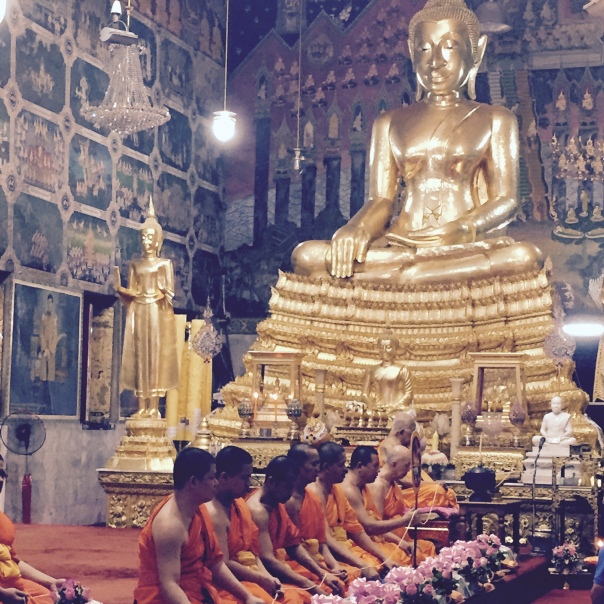
Bangkok
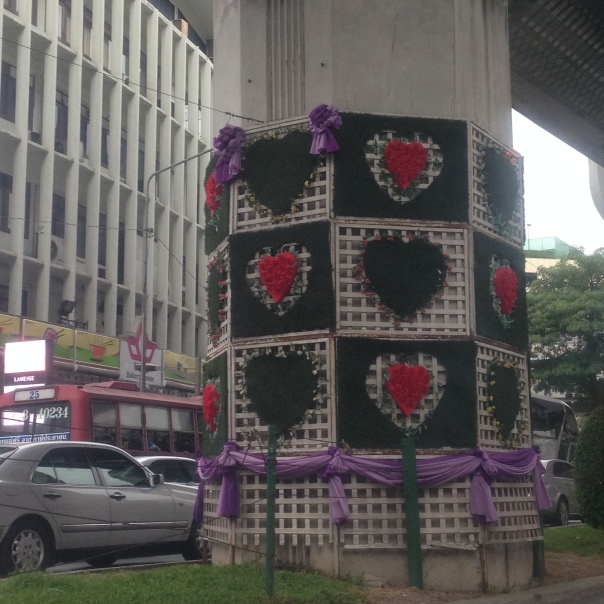
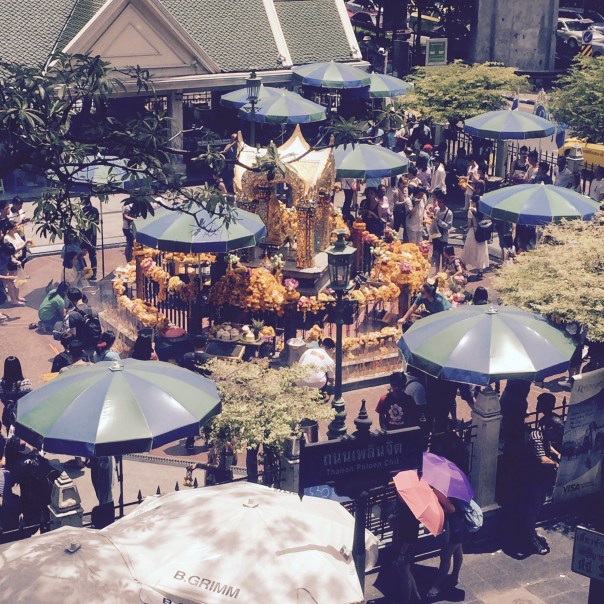
My last sojourn involved being based in Bangkok, which is a great city, when you’re well paid and can afford the lifestyle it has to offer. For the more fortunate ex-pats the choice of really good accommodation close to the city is extensive and the high prices reflect the quality of what’s on offer. I may as well be living in a caravan if I don’t have an oven in the kitchen and when I lived in Manila I had a two-ring stove and a microwave that never worked. After some time I found it just plain depressing not to have access to a decent oven, especially when I didn’t consider Filipina food up to my gourmet standards. My stipulation that the apartment must have an oven in the kitchen guided me on what was available for the price range. The Thais like to eat out and as most non-salad food is fried, there are few apartments even in the high-end range that offer an oven in the kitchen.
I got lucky in my quest for living accommodation and ended up in a very large 2-bed apartment located just off the main shopping area. It was situated on a minor soi (side street), sufficiently out of the way so as not to feel overwhelmed by tourists but removed from the noise and the bustle of a big Asian city like Bangkok.
Before Bangkok became the big bustling Asian city that it is, it was made up of a series of lanes and alleyways that defined the city. All human life lived in these lanes and alleys. You could buy anything you needed from fruit to fridges, sinks to sofas; have a haircut; enjoy a massage or eat your dinner on the side of the road.
Shortcuts
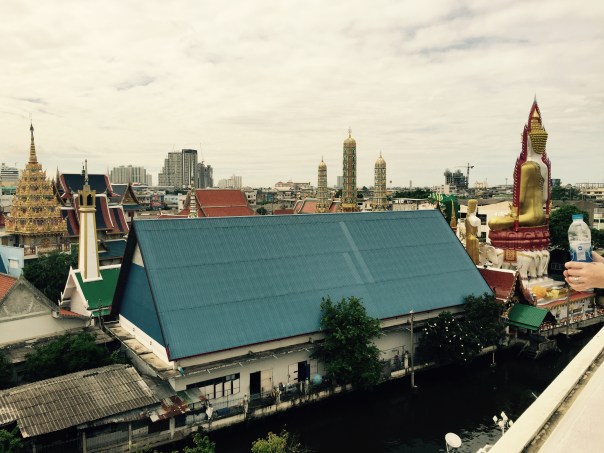
When I moved into the apartment in Bangkok, you could take a ‘shortcut’ to LuanSuan, an upmarket street, which is home to Gagan Restaurant one of the top three restaurants in Asia (and serving the most fantastic Indian-fusion food). There are also some decent restaurants on the street and access to the Bangkok Transit System (BTS). The shortcut was a series of small narrow lanes, with a huge tree almost similar to a willow tree more common in Europe, whose branches hung low, forming a semi-circle, marking the entrance to the laneway. You felt as if you were stepping into another world, and indeed you did step in to some unique culture, that’s not found in many other cities or places.
Motorcycle taxis weaved between the street food-sellers, the cyclists and the pedestrians who frequented the street. There were several massage parlours and the women would sit outside on the steps when there were no customers, often eating meals there. There was one or two hair salons, a house where English lessons were conducted from the open carport at weekends, small grocery stores and a variety of eateries from a colonial style house converted to a restaurant, to small family run restaurants. The small restaurants usually entailed some plastic chairs and tables on the street and a mobile kitchen with open fire and boiling pots of fat for cooking – little regard for safety there. The plastic dishes from the restaurants were placed into large buckets and in the evenings as I took the shortcut home, the owners would wash the dishes on the street with water from an unidentified source. Sitting among cockroaches one evening while eating at one of these restaurants guaranteed a lost of appetite and I didn’t repeat the experience. I was also turned off from eating local when travelling by car one day, I noticed two restaurant workers, during a quiet period sitting beside the kitchen and one woman was scouring the other’s hair for head lice.
Luan Suan itself is an upmarket street with lots of ongoing building construction at the top of the street towards Lumpini Park. I had a few friends who lived off Luan Suan and would frequently walk over to them for dinner. Garbage from the restaurants would be left out in plastic bags on the sidewalk, ready for the bin collectors to come at night and clean the streets. As you walked up the road, rats would scurry out and of the bags of rubbish and scatter at the sound of voices or footsteps. I had never seen so many rats in my life and the open drains gave them easy access to scurry up and down the road. I took to walking down the street clapping my hands like some mentally deranged eccentric, but it worked and I once spotted seven rats scurrying out of some plastic bags, down the open drains.
The number of rats around food helped my decision to shop in the supermarket. The other option was to spend the day going from market to market to buy vegetables and then trying to find transport to do so. The variety of vegetables and fruit is remarkable but then you have to know how to cook the local food to really experience the scale and variety of food on offer. I tended to stick to what I knew, but paying Irish prices in a country where labour is cheap is upsetting added to the fact that there is some conglomerate capitalist rubbing his greasy palms at the prospect of massive profit.
Super-markets
Bangkok has many expats living in the city and the supermarkets cater to all nationalities. There’s nothing (well, maybe Helmanns mayonnaise) that you can’t find in the big supermarket from smoked salmon to salami, but I frequently chocked on the prices I paid. For some reason instant coffee is a premium produce with security tags on jars of Nescafe, the way you’d see them on bottles of whiskey elsewhere. A 100 gramme jar of coffee costs about €20. The cost of wine in the country is outrageous and after India, Thailand has the second highest taxes on wine in the world. A bottle of Carlo Rossi (the cheapest, most awful wine in the world) is about €20 a pop, so I would use every opportunity when travelling to bring an extra large suitcase and lots of towels to wrap enough wine to open a small shop.
Members of high society in Thailand like to be seen drinking wine in the roof top bars of the fancy hotels dotted around Bangkok. It’s considered a status symbol and gives these posers, a sense of sophistication. You can’t buy booze in the afternoons, apparently because children get out of school during this time and the king thinks it may influence the younger generation.
Royalty
Any public criticisms of the king of Thailand, no matter how minor, will ensure a long jail term. It is difficult to access if he is genuinely as popular as the media make him out to be, as saying otherwise would ensure time behind bars. According to the media, there is a fierce public loyalty to a man who is reputed to be one of the wealthiest in the world and whose family behave like feudal overlords in the 17th century. At the cinema the national anthem is played before every movie and if you don’t stand to attention, then I dread to think of the consequences. If you happen to be walking in Lumphini Park at 6 p.m. or past a military establishment, then you must stop while the anthem is blasted over megaphones. The city is littered with enormous posters of the king and queen over many years. In one poster, himself is dripping in sweat and when I asked one day why would you use such a picture, I was told that it reflected how hard he worked for the Thai people. The notorious traffic jams in Bangkok are frequently caused by military escorts forcing the traffic to stop as a motorcade containing members of the royal family, going to or coming back from shopping sprees!
Happily there is one unmarried princess, who works tirelessly for the poor and marginalized in a deeply divided country. The 87-year old king is crippled with failing health and lives in his own personal hospital. His queen is similarly in bad health after a stroke in 2012.
The heir apparent, the Crown Prince (63) is surrounded in controversy. His dog Foo Foo was promoted to the rank of Air Marshal and on his death received a four-day Buddhist funeral followed by a cremation. On the dog’s birthday, photos were released of the Prince’s naked third wife and the dog at a birthday celebration (he is now on his fourth wife, according to reports). Many Thais, who would prefer to see his 60-year old sister, known for her altruistic and charitable work, accede the throne.
The support for whoever accedes to the throne very much depends on the military who are the real power kingpins in Thailand. The first woman prime minister, Yingluck Shinawatra was removed through a military coup in 2014 and there are no signs of any early return to democracy, despite promises of reform. Shinawatra, is a wealthy businesswoman whose eldest brother Thaksin was also a previous prime minister. Reports accuse her brother, who fled the country when he was deposed, of ruling through his sister and using power to further business interests. It’s very much an urban/rural divide with the Shinawatras’ being voted in by and representing the rural population. When there was a water shortage due to El Niño in 2015, the government cut off the water supply to the farmers while car washing and water for plants was still available in Bangkok.
It will be interesting to see what will happen when the king dies and many believe that the military will use his death as an excuse to remain in power, until things settle down. An Irish friend who believes the king’s death is imminent is stacking up on bottles of gin for over a year now, as he believes there will be a ban on the sale of booze in the kingdom for at least six months after the royal death!
Another form of Chinese torture
Unlike the price of booze, the Thai massage is famous and costs as little as €10 for an hour’s therapy. The local massage comprises of slight women walking on your back and yanking limbs and muscles you never knew existed. Language can also be a problem and much to my shame my Thai was limited to giving instructions to taxi drivers and some basic words for hello, thank you and wrong number etc. This made finding a decent masseuse a hit-and-miss affair, trying to explain that I have an arthritic hip and it shouldn’t be yanked or I’ll scream the house down with pain. Indeed a greater challenge was finding therapists who had some kind of qualification.
A Japanese friend who previously lived in Bangkok, pointed me in the direction of the Chinese massage spa just off the BTS. The place fascinated me and was just a 10-minute train ride from where I was living. It was on a minor soi and when you turned into the compound a couple of dogs lazed under the trees to escape from the heat of the day. This was no luxury spa – there were two rooms and a row of uncomfortable wicker chairs in both rooms. There was a third room with a plastic sliding door that was almost permanently pulled shut, which fascinated me; well at least what was behind it interested me. It was like some form of religious temple and there were days when lying on the wicker chair and for the want of something to look at, I would strain to get a glimpse of what was going on inside. Some days when it sounded as if there was chanting and on one particular day tens of young people poured out, as the door was firmly pulled behind them. There were very few foreign clients, but some pretty fancy cars with Thais or Chinese would pull up outside for this no frills establishment. Lots of certificates covered the walls and like most other places there were some therapists who were better than others.
You couldn’t make an appointment because of the language barrier and I’m not sure they even took appointments, so you ended up with whatever therapist was next in line. Like most places there were good and not so good therapists, but I hated when I arrived and it was ‘Granny’s’ turn. The woman must have been in her 80’s and she had a habit of holding my foot under her armpit while working on the other leg. Another woman, who appeared to be the boss, spent most of her time watching Chinese soap operas on her smart phone. They must have been short of staff one day when I ended up with her as a therapist and she had some English. Without doing anything else she touched my feet and told me my knees were inflamed and then pointed to my hip. She pointed out some other ailments by just touching my feet; I have to say I was fairly impressed by her skills.
The type of massage practiced by the Chinese was Rwo Shr, brought from Taiwan by a Swiss priest Father Josef Eugster, who introduced that particular method to many countries in Asia. Many people like to be cosseted in a spa with essential oil and have a massage that makes them fall asleep. I much prefer to have a medical massage that sorts out some of the pains and aches I have developed with increasing age and I have to admit, despite the excruciating pain experienced during the massage, I came out walking on air and feeling fantastic.
I recommended the Chinese massage to a few friends, some of whom are yet to forgive me for the pain they endured and who have never returned to these gifted Chinese therapists. I eventually found something nearer home, practicing the same method of reflexology, but with much more comfortable chairs and soothing music in the background to take my mind off the pain.
Bangkok is a big, brash South Asian city where everything and anything goes. It’s exciting and exhausting, it’s hot and sweaty; it’s rich and poor. But whatever it is and however it wears you down at times, it’s an exciting place and there’s always something new on the horizon – it just depends on how you look at it.
 More than 120,000 people, most of them children, are at risk of starving to death next year in areas of Nigeria affected by the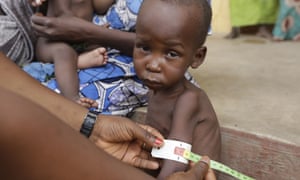

 We travelled to Banki on Wednesday 28 September after a 45-minute helicopter trip. The Nigerian Armed Forces controls the town and its officers are understandably paranoid about the possibility of Boko Haram attacks. Citizens are not free to move beyond the perimeter of the town for fear they will share their miserly food allowances with the rebels. Some believe there is a strategy to starve the rebels, but if that is so, then it is also affecting thousands of innocent people left without insufficient food on a daily basis.
 and is open just a few days each week. Hundreds of people queued outside in the heat of the sun waiting as the nurse performed triage, making decision after decision on which patients needed immediate treatment and who could be treated for minor ailments or left for another day to see the medics.
 care moved her to the car where she could recharge the battery. A while later the medic came back into the tent and I asked how the baby was doing, the doctor responded that she was hopeful of a recovery. In order to get Fana to a better-equipped hospital for treatment, they needed a military escort for the ambulance to protect them from Boko Haram attacks. With no reason given, the military refused the escort.
 who live below the poverty line, and in conditions that are incongruous to what should be happening in the 21st Century. These crushing levels poverty with zero quality of life, where children die unnecessarily is just fodder for Boko Haram recruitment.


 Moving country, moving house, changing job, divorce and the death of a partner are reported to be some of the biggest causes of stress. The first three mentioned on that list, I’ve experienced with far too much regularity.

 FagansBlog