Tag Archives: travel

Hip Hip Horray

During those dreadful COVID years I became disillusioned with living in an apartment, the constant turnover of renters/neighbours, sharing the common areas and bins with people who just don’t ‘get’ or respect communal living. One fine autumn morning in 2020 at the height of the pandemic, a chance meeting with an estate agent in the hallway turned into a pure serendipitous encounter. It was the beginning of a journey which turned out to be the start of preparations for the next step in my life journey, Phase Three. The estate agent reassured me that I would have no problem in selling the apartment, so after a couple of false starts, the sale went through and I found myself moving a few kilometres down the road to a little bungalow where I found myself alongside neighbours; the kind who took in the bins when I was travelling and where we could swap hall door keys for cases of emergency.   I had found my tribe.  On one side I have a couple who are of similar age and on the other side of my new home, a young couple who were full of joie de vie, I couldn’t have knit better neighbours.

Moving on

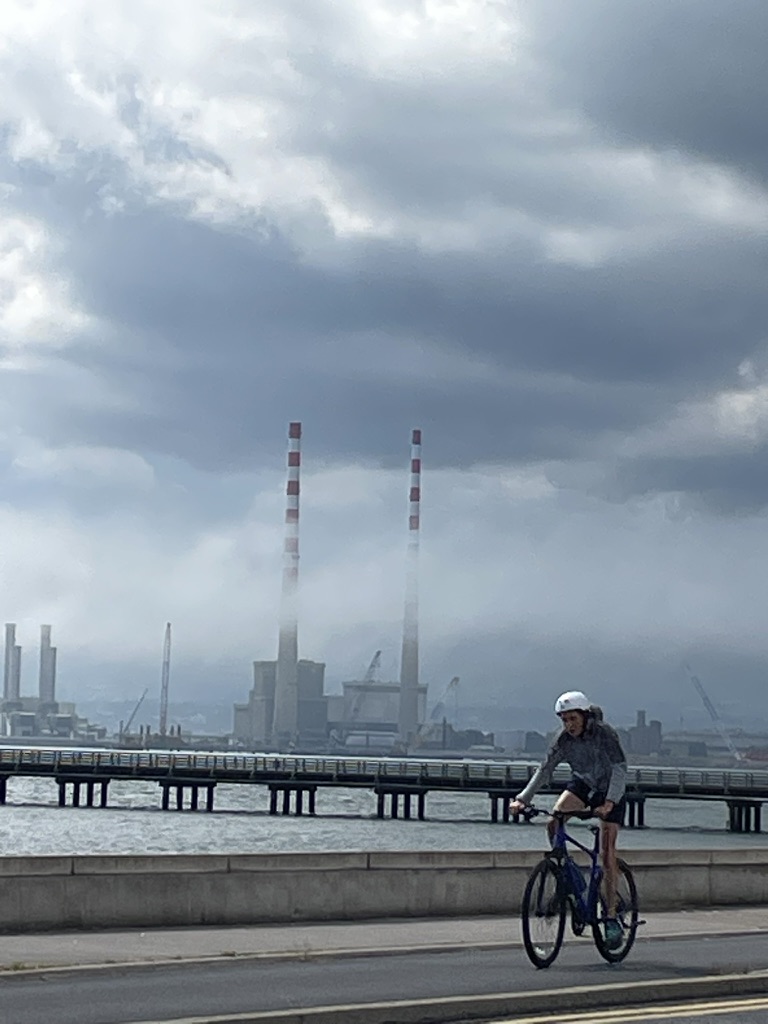
Now almost five years on life continues, albeit with a slower pace than the heady days working with the United Nations. I still travel abroad for work when contracts become available, and when tides permit, summer or winter, I walk across the road for a sea swim off the Bull Wall, take in some music gigs, theatre nights and generally enjoy life.  I joined a local over-55s Pilates class to improve my flexibility and maintain fitness.  Last summer, the instructor had us lying on our side, balanced with one arm firmly planted on the floor and she requested that we lift our top leg. This bit was easy peasie;  but then she suggested we lift the leg on the floor to meet the raised leg.  To my horror, try as I might, my right leg wouldn’t budge. It could have been super-glued to the ground there was such little movement.  It was the only symptom that indicated I required a replacement hip. Since my new left hip replacement 10 years previously I had continued doing the physio exercises, so I was gobsmacked when the orthopaedic surgeon informed me that if I had ignored the signs for another six months, I wouldn’t be able to walk such was the poor condition of the hip.   Don’t get me wrong, I’m not moaning… shit happens once you reach a certain age and the years of enjoying life and giving it my all, has taken a not unexpected toll.  However, for once in my life I was organised and when I moved into my little house, the Phase Three groundworks were put in place with alterations for the inevitable.

I had no trepidation about checking into hospital on 1 July to undergo surgery. I knew what to expect and was mentally prepared for the post-surgery recovery.  On the day after surgery, the hospital physio came by to ensure I could climb and descend stairs without putting too much pressure on the hip. I don’t believe he was that long at the job, most likely just qualified. I had to stand holding a bar on the wall and swing my leg sideways. Not an issues with the left leg, but the right leg was sweeping the floor and in my innocence I believed that there was a building error in the way the floor was laid which caused  a slant. It turns out that my operated leg is now 5 mm longer, which is, by all accounts, a common occurrence after hip surgery. Who knew?  As I expected, I couldn’t bend down for several weeks or the hip would pop and so I had to employ the use of a ‘picker-upper’ that never seemed to be in the right room or the right place, when it was required. Being inherently lazy (and I like to think I’m creative about it), I learned to slide the operated hip behind me as I attempted to pick things up from the floor. If I forgot to bring the implement into the bathroom, putting on underwear could be compared to a rodeo rider trying to lasso a calf as I attempt to get the leg opening of my pants onto the foot of my operated leg. If the picker-upper made it into the bathroom, I was like a crane driver hovering, trying to dump a load of bricks or whatever, on to the correct spot. I became an expert in hooking things onto the end section of the crutch and flinging the item onto a higher surface. Terrified to bend down, I had to visit a chiropodist to cut my toe nails, which came possible when I could drive again week four post-surgery.

Spine-less

Prior to the whole shenanigans of the hip episode, I was on a mission to the Philippines as an election observer. I was still on a training course in Manila when I received a phone call from an Irish number.  My thrifty-self went into action, at €3 a minute to receive a phone call, I almost gagged when a spine surgeon’s assistant began babbling something about an MRI result sent by the hip-man to the spine-man’s office and I  needed an appointment. The assistant spoke about a spine surgeon, not a spine specialist, or a spine doctor, but a surgeon. For the next six weeks of the mission I imagined all sorts of doomsday scenarios as to why a spine surgeon would want to see me. Despite my imagination going into overdrive, I stubbornly sought out my favourite Japanese massage chain in Manila, Karuda. I always like to see qualification certificates hanging on the wall when I go for a massage, and I knew from previous visits that the staff are particularly well trained, which is reflected in what are considered to be outrageous charges in the Philippines! The treatment is around €30 for a body alignment, in comparison to having a ‘masseuse’ on the beach  walk over your back for as little as the equivalent of €5. I didn’t realise when I was having the treatment that the cause of the excruciating pain in my back could be connected to why the spine-man wanted to see me. (If I was writing in emojis, I would include an eye roll and a hand over forehead here).  However painful the massage, at least I had good circulation prior to taking a 20-hour flight back home.

On my return and before the new hip was installed I visited the spine-man. The surgery was optional, he announced. However, there was a caveat; my L3 and L5 (I think) were in trouble, and it was my choice whether I looked forward to a quality of life in the Third Phase, or without surgery I was guaranteed zero quality of life and would become incontinent. It was a no brainer and so, 10 weeks post hip surgery, I had my lower back decompressed and spine shaved to open the spinal canal. Just two days in hospital and then discharged on day three. You couldn’t exactly describe me as the most patient patient. Between the hip and the spine, everything  was taking three times as long and some tasks were just impossible. Luckily I took a decision earlier in the year to have the bathroom gutted, by removing the bath and installing a walk-in shower.  The bathroom was totally revamped in anticipation of growing older, I just didn’t expect  older age to arrive less than six months later.

Return to the Philippines

I was very glad that I had packed in some travel in the first half of 2025 before undertaking the surgery and it was really interesting to revisit the Philippines 11 years since my last sojourn there. I was part of an election observation mission and the participants underwent a week’s training in Makati before our departure to the field. It was good to revisit my old stomping grounds, staying in a hotel about 20 minutes from the building where I once worked. I chased down a few friends/former colleagues to catch up and took an opportunity to pay a visit to the People’s Palace, located in Green Belt III where they serve the best pomelo and prawn salad, that never fails to please the palate. Many the times I tried to recreate the dish at home, paying a small fortune for a pomelo, but I never came close to the dish served up in the People’s Palace. Green Belt hasn’t changed much either, full of designer shops catering to the wealthy who can be found swanning around with poodles in nappies (diapers).

Disappointingly, not a lot has changed in terms of lifting people out of poverty, improving road transport, price increases or a greater awareness of diet and healthy eating.  The Philippines is located in the Ring of Fire, an area in South East Asia prone to extreme weather events with several typhoons each year alongside frequent earthquakesre and active volcanos. There are still millions of vulnerable Filipinos, many in rural areas who live in shacks rather than well built homes, working in poorly paid jobs just about making enough to survive. And then there is the opposite end of the scale, the wealthy dynasties, the likes of Marcos family and the elite classes, manily land owners, business people and politicians. A small example is the the cost of a cup of coffee which is almost as expensive as in Ireland. Speciality coffee shops are as ubiquitous as mosquitos and prices as high as €3+ for an Americano. The most common variety available to the less wealthy is instant coffee and as a coffee snob, I rather drink a cup of tar than instant coffee.
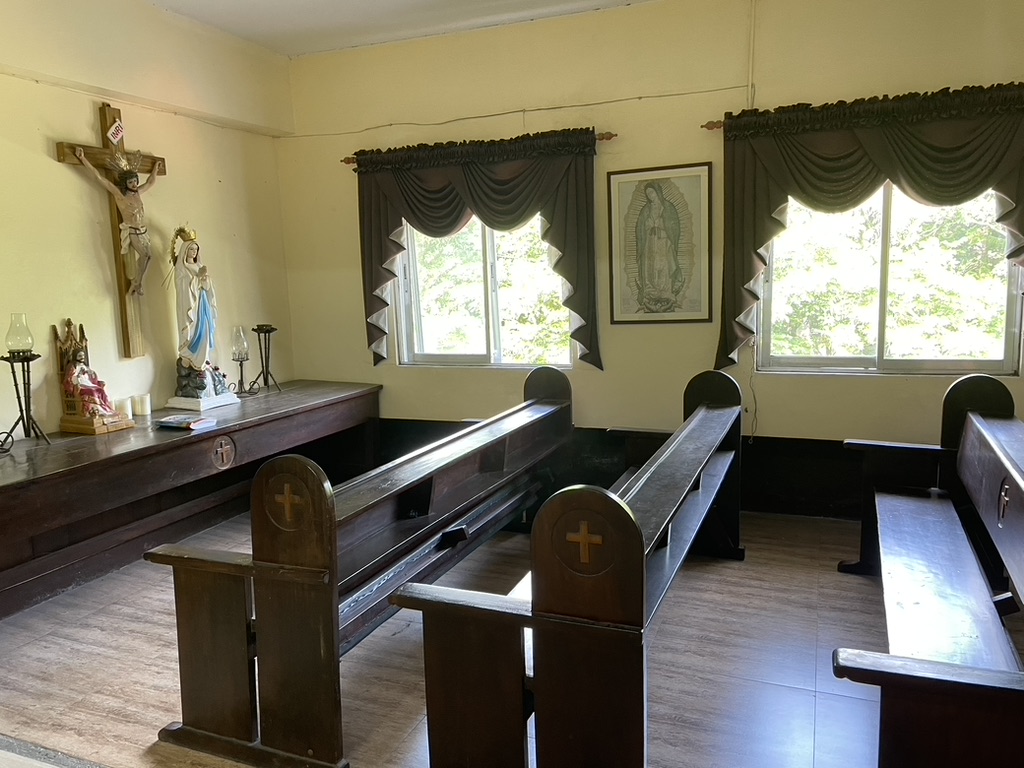
In terms of religious belief, the Philippines remains a mostly deeply Catholic country, so much so that we came across a chapel in a local public office, should you feel the need to redeem your soul in the middle of the work day.

Metro Manila is the seat of the government and Manila itself is made up of a series of cities, divided into 17 local government units, 16 of which are cities namely, Caloocan, Malabon, Navotas, Valenzuela Quezon City (the most populus), Marikina, Pasig, Taguig, Makati,  Mandaluyong, San Juan, Pasay, Parañaque, Las Piñas, Muntilupa and Pateros as the lone municipality.  When I lived in Makati, the wealthy area of Manila, the traffic was impossible and I was lucky to be able to afford to live down the road from the office, so could walk to work. Crossing the city can take many hours, and I didn’t see any signs of extending the outdated and overcrowded metro line.  Most workers coming into the city for work rely on public busses, called jeepneys.  Jeepneys originate from the American colonial- period where they are used as shared taxis. These evolved  to modified imported cars with attached carriages in the 1930s and served as cheap passenger utility vehicles. As of 2022, there were an estimated 600,000 drivers nationwide dependent on driving jeepneys for their livelihood and in Metro Manila an estimated 9 million commuters  use jeepneys each day.  Indeed, the traffic issues are not exclusive to Manila. For the election mission I was based in Tagaytay  just 50 kilometres outside Makati and travelling to visit the electoral areas took hours each day, such was the volume of traffic on the roads. 
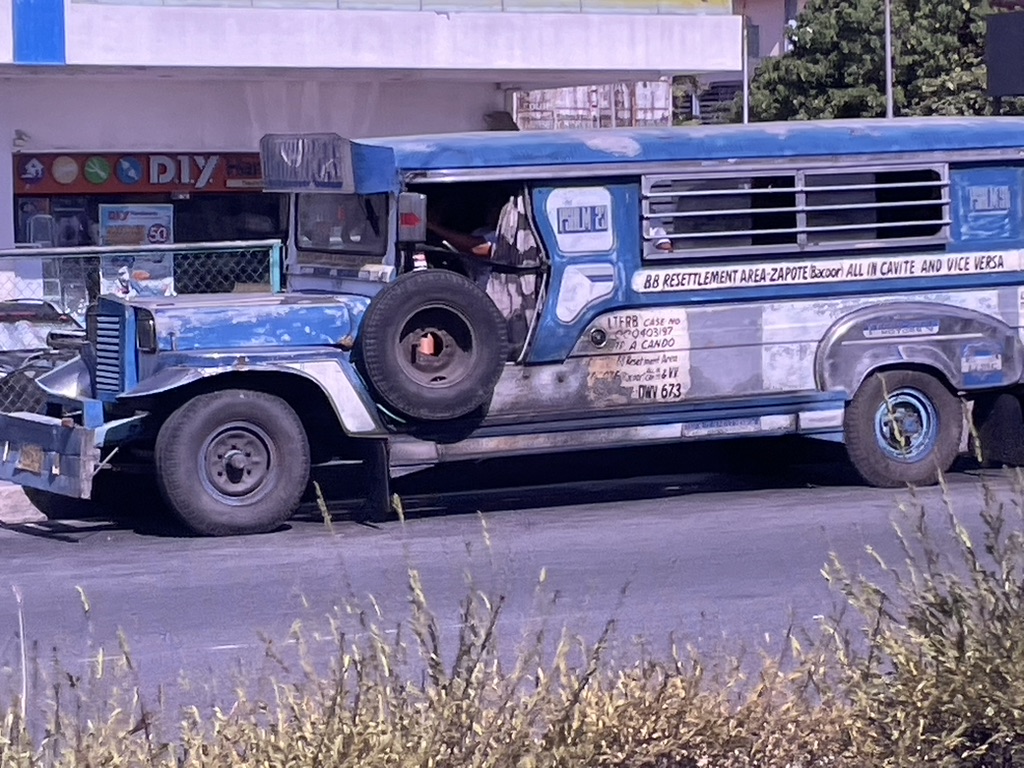
Jeepney

Zero improvements in traffic management were made in the years since my previous visit, and sadly neither has the eating habits of the locals. According to the latest World Health Organisation nearly four in 10 Filipino adults and one in 10 children are classified as overweight or obese. The consumption of sugary drinks, fast and ultra processed food, alongside limited access to nutritious food contribute to the increasing cases of Type 2 diabetes. The pervasive fast food outlets are rife and to be found on every street. Try eating in Jolly Bees and you could be eating chicken or beef, it’s impossible to tell the difference. A McDonald’s breakfast is a regular morning ritual in the Philippines and there are zero healthy options in the fast food outlets which mostly offer highly processed food, full of empty calories. Shaky’s is the local pizza parlour and probably the healthiest of the fast food joints, if indeed, you could call any of them healthy. The best option for wholesome food is in the Makati malls, or if you’re lucky enough to be near the coast, there is a fantastic and plentiful selection of fresh fish.

All in all 2025 was a busy and interesting year, but I was glad to see the back of it and so with a new hip and a straight back, let’s see what’s in store for 2026, so far it’s looking good.

No AI used in this manuscript.

Unbelievable Uzbekistan

When I was working, I was privileged enough to visit several of the ‘Stans’; Pakistan, Afghanistan, Tajikistan and in October 2024, I went on an assignment as an election observer to Uzbekistan.  Located in Central Asia, Kazakhstan lies to the north, Kyrgyzstan to the northeast, Tajikistan to the southeast, Afghanistan to the south and Turkmenistan to the southwest. Uzbekistan is one of two countries in the world that is doubly landlocked, meaning it’s surrounded by countries that are also landlocked. The only other country with the same  geographical anomaly is  Lichtenstein in central Europe.

I arrived to Tashkent, the capital of Uzbekistan as part of an election observer team, a few days prior to polling day.  Autumn was in full swing and apparently the height of the tourist season – (summer temperatures rise to 40 degrees Centigrade and by all accounts, unbearable).  With so many tourists in town, we were asked to share a hotel room with a same sex observer who was also part of team covering our assigned area in Jizzakh. To say some people had a hissy fit at being asked to share a room would be an understatement;  although the terms of reference for short term observers stipulates that flexibility is a core requirement and conditions may not always be desirable. One Polish ‘diplomat’ packed her bags and fled in the middle of the night when she discovered she had to share a room. I got to share with a young, mini-skirt wearing Bangladeshi/German who, when she wasn’t coughing all night, could wake the dead her snoring was so loud. When my earplugs didn’t stop the din of the snoring or coughing, the next morning I asked her to visit the pharmacy for a cough suppressant, so she stopped speaking to me. Although I was the only Irish person staying in the Hotel Ramada, I wasn’t short of company and got to hang out with Tara (the Tory).  The ideology of the Tory party in the UK is possibly the direct opposite of my own political beliefs so I never imagined that I would enjoy the company of somebody who was a member of the Conservatives. I do think that Tara was a bit confused about her political loyalty and was more of a social democrat when you scratched the surface. Her saving grace was that she had voted to remain in Europe, rather than voting for Brexit so the Irish contingent had no issue in including her for dinner and extracurricular activities.

Modern Tashkent

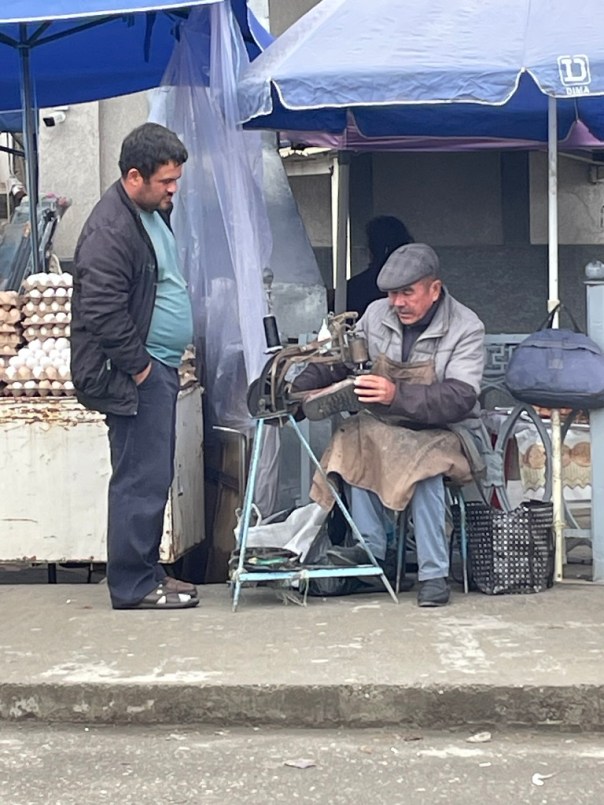
The flight from Dublin was more than 12 hours if you took into account the stopover in Istanbul (my least favourite airport in the world). After a long night’s travel and with little sleep, most of us took a short nap after we checked in. In the early afternoon Tara, myself and another Irish woman headed out to explore some of Tashkent. The hotel ordered the taxi and we made our first stop at Chorsu Bazaar on the southern end of the old city.  I felt a little disappointed as we wandered through the section where craftsmen (and hopefully women) sold instruments for making patterns on bread, handmade cots and toys for babies.  Almost giving up because there wasn’t much to interest us, we crossed the road to the indoor section of the bazaar which was covered with a large dome, where we found ourselves in the meat section of the market.

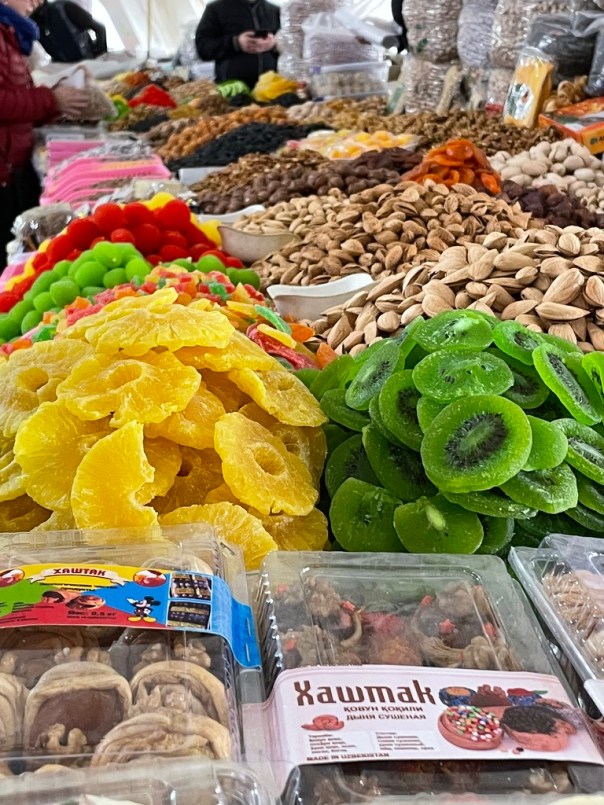
Chorsu Bazaar, Tashkent

It was a vegetarian’s and vegan’s worse nightmare. Horse meat, liver, animal trotters – you name it, it was there, but the most surprising aspect was the absence of flies. Now I’ve been to dozens of African markets where the flies were so thick it was impossible to see the meat and if you did buy meat it had to be boiled for hours before there was any guarantee you wouldn’t end up on death’s door in a hospital with food poisoning.  The upper floor of the bazaar was a treasure trove of dried fruits and a fabulous collection of spices, including saffron, the most expensive spice in the world with a retail value of around US$3,000 per kilo (depending of course on the availability and market rates). Saffron comes from the crocus sativus flower and the best quality and largest producer of the world’s saffron is Iran, although there is now a heavy investment in producing the flower and ergo spice in Uzbekistan. 

Very few people speak English, so making our way around was challenging and we found ourselves wandering aimlessly, attempting to seek directions from locals at the market and failing miserably through our use of using sign language and finger pointing. We were fortunate though and ended up coming across a group of English tourists with a Uzbeki guide to point us in the direction of the Metro to meet up with the remainder of our group for dinner. One member of the tourist group kindly provided us with a metro map and loose instructions on the metro’s location. After wandering around the outdoor section of the market, we eventually found the elusive Metro. Perhaps it’s a symptom of having few visitors to the country but people stopped to help us everywhere. A random Uzbek woman took us under her wing and insisted on accompanying us to the station where we were to transfer to another line. With two of us being older ladies, passengers stood up to allow us sit down and wouldn’t take no for an answer. When we reached the transfer station, our unofficial female guide was pointing us in the wrong direction when a young man who had been listening to the lady, interjected, indicating that we were going the wrong way and accompanied us to the platform for our transfer. It was so refreshing to receive such hospitality and it was also a great opportunity to interact with the local people. It is often said that the Irish are friendly, but we are in the tuppence-halfpenny place by comparison to the hospitality and friendliness of the Uzbeks.

On day two of our mission we attended training and a briefing on our area of responsibility. It’s policy to match up a male and female observer from two different countries to work together. My previous observer mission was Ukraine in 2019 when Vladamir Zelensky was elected and I ended up with a gun-toting Trump supporter as a partner. To say we didn’t meet eye to eye is an understatement, he was trying to tell me that electricity created through windmills killed millions of birds and that it was a misnomer that oil damaged the environment (incidentally, he worked for the oil industry – quelle surprise). I thought at one stage he would burst a blood vessel he was so annoyed when I pointed out that his hero the B-rated movie actor Ronald Regan, suffered with Alzheimer’s and consulted a fortune teller for guidance while he was president of the US.   Thankfully, my partner on this occasion was a Norwegian married to a Russian woman and living in Moscow. Lars works with Ukrainian refugees in Moscow and speaks fluent Russian, which proved very beneficial, but that wasn’t his only attribute; he was simply a very nice affable man with a sense of humour, which made him an excellent partner.

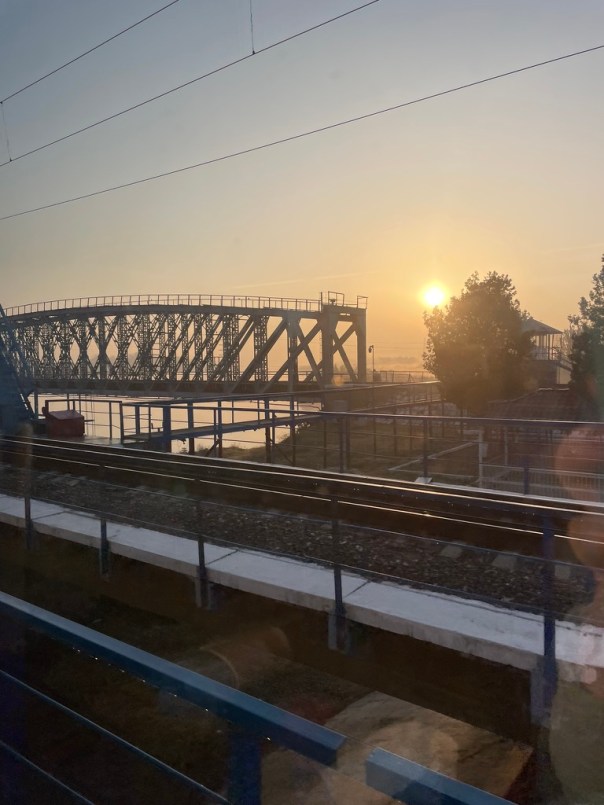
On day three we found our way to the train station for an early departure from Tashkent to Jizzakh. Catching a train in Uzbekistan involves checking in with a passport as proof of identity and where luggage is scanned at the entrance just like at the an airport, so a late arrival just adds unnecessary stress to the journey. We arrived in good time and took the 95 minute journey in a Russian-built train, that was super clean and super-efficient. As a coffee snob,  I declined the free coffee that was delivered to all passengers with a free croissant, included in the price of the ticket. It was a terrific opportunity to see some of the countryside and get a sense of life for the average Uzbeki. The final destination was Samarkand, a further 30 minutes south and an extraordinary city with a big tourist draw.

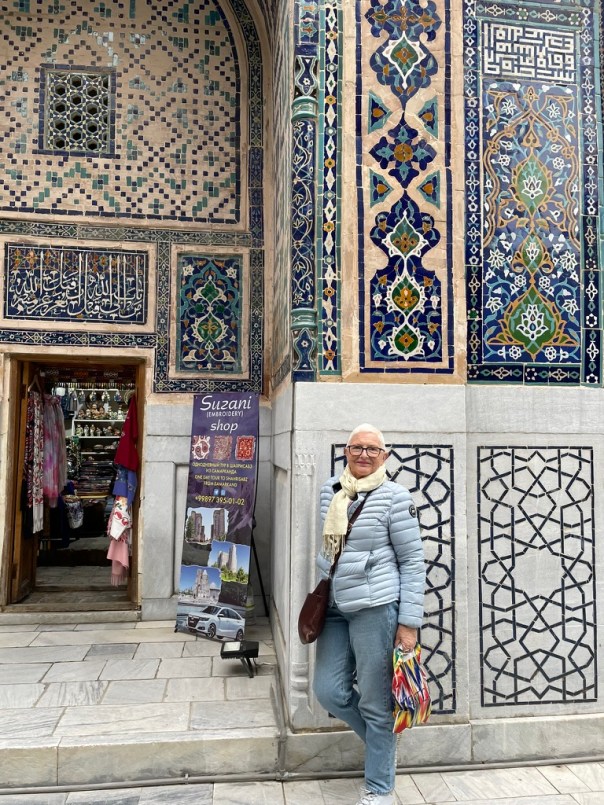
Samarkand Madrassa

We thankfully didn’t have to share a room in Hotel Za’faron in Jizzakh. The hotel was located in a business compound and the owners employed an international chef to cook some traditional Uzbek food. The food was excellent and I just couldn’t get enough of the pumpkin soup which is beyond delicious; so much so, I’d get up in the middle of the night to have a bowl of that soup given half a chance. As I mentioned earlier, a visit to Uzbekistan for a vegan or vegetarian would be almost impossible but what I found extraordinary was that I didn’t see one obese Uzbek person for the eight days of the trip. I can only put it down to the fact that the diet in Uzbekistan lacks the food additives found in processed foods in all supermarkets in the West, and most of the food we ate was made from scratch without the nasty chemical preservatives or palm oil.

The long-term observers who had worked for weeks before our arrival and managed our deployment, met us at the station. We  transferred to our hotel to discuss the assignment and it was still only 11:30 when we finished the meeting and introduced to our driver and interpreter. The main spoken language is Uzbeki, with large numbers of the population also able to speak Russian.  Indeed, our translator was a lecturer in the local university of Jizzakh where she taught English. Almost every town and village had English language schools, a sign that the country is working on expanding its opportunity to do business outside Asia. Without any official duties and rather than waste the remainder of the day, we took off for Samarkand to see what the big fuss of the tourist draw was about. While the trains were super comfortable and efficient, I couldn’t say the same about the roads.  The distance between the two areas is just 100 kms and it took us the best part of 2.5 hours to reach Samarkand.

The weather gods were disappointing and we arrived to a cold and drizzling rain, but it didn’t take away from the magnificence of the three madrassas in Registan Square that have stood for centuries.  The oldest madrassa is believed to date back as far as the 15th Century and these unique buildings are covered in fabulous tiles.   Samarkand is more than 2,750 years old (one of the oldest cities in the world) and stands at the junction of the old trade routes. The sheer size and majesty of the three buildings draws wedding parties and engaged couples for photo opportunities, and it was interesting to see so many wedding parties gathered on the day we visited. Walking around the inside of the buildings, what were once classrooms and libraries for young boys to learn the Koran were turned into handcraft shops selling quality crafts where it was compulsory to bargain with the shop owners.

A happy newly-wed couple in Samarkand.

Our driver and translator were born and lived in Jizzakh. The driver worked in a local factory for his day job, taking leave to drive us for the few days. He was quite a handsome man but I was bemused when his smile revealed a bottom row of gold teeth. There may have been a time when gold teeth were fashionable, but like the current popular fashion of chemically puffed up lips that turn most women into something akin to Donal Duck, there’s nothing attractive about gold teeth.  The driver wasn’t the only person I met with gold gnashers, one woman I came across appeared to have replaced every tooth in her head with a gold crown. There were days when I felt I was on on the set of a James Bond movie intreracting with all the baddies.

Our area of responsibility was around the town of Jizzakh and also partly in the countryside on the outskirts of the city.   We spent the day before the election doing a recce, visiting the polling stations and introducing ourselves to the polling staff who were conducting final checks to ensure everything was in order. All of the polling stations we visited were schools and most were ultra modern. One newly built school we visited has the capacity for 1,600 students and as a new build with a new housing estate nearby, there are already 1,000 pupils enrolled. A very capable headmistress was chief of the polling station. At one stage during our visit I asked for the bathroom and was escorted down the corridor by one of the election workers. On my way back I peeked into a class room to see 20-25 tables laid out with chess boards and realised that chess is a subject like Geography or History in Uzbekistan. I was very impressed that school children are being taught strategic thinking from a young age – every school child should learn how to play chess!!

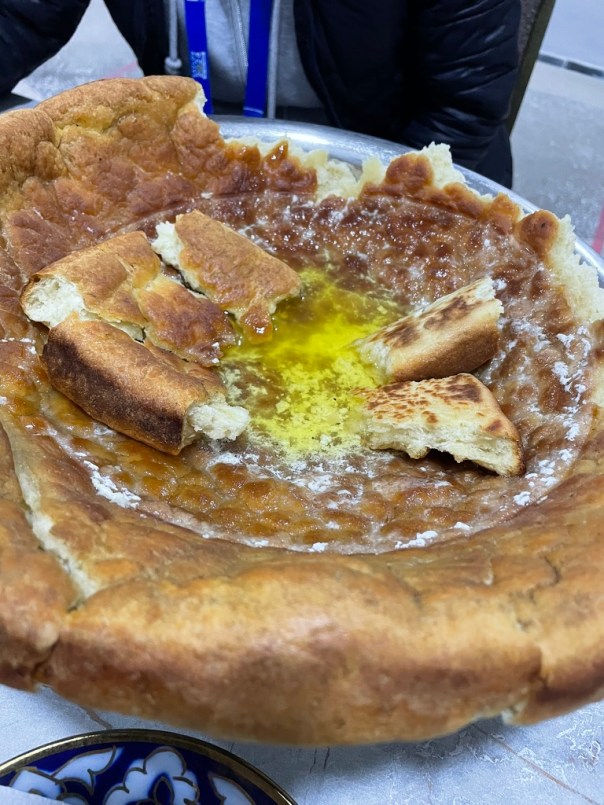
Like the Uzbeks we met in Tashkent, everybody was super friendly at the polling stations. When we arrived  for a recce to our designated polling station to observe the count, the local head of the council insisted that we shared food and drink tea with him. The local fruits were really high quality and the melons and apples the sweetest I have ever tasted. On the night of the election we arrived at the polling station as darkness fell about 30 minutes before the end of voting. We wanted to observe how procedures were followed and how efficient was the balot count conducted.  As night fell the room became cold and more food was brought in. This time it was hot bread in the shape of a bowl with a quarter kilo of butter melting in the centre –a heart attack on a plate!  I picked at a corner of the bread ever mindful of my cholesterol levels and had a taste of the pastry wrapped around meat presented to us.

Hot bread with melting butter.

Once a rhythm was established for the vote count procedures it was obvious that the chief of the station had everything under control and it wasn’t his first time to organise a count. Some of the staff who had finished the count early for their assigned locality, succumbed to their natural curiosity and moved in our direction for a chat, or best described as more of an interview. When the men wanted to know where we were from, Lars mentioned he was Norwegian and I intimated I was Irish. There was a look of immediate recognition when they heard my nationality and in unison a group of five or six men said “aaah Conor McGregor.” I was so embarrassed that the Uzbeks related Ireland to this horrible man who was recently sued for the rape of a woman. It brought to mind one of one my late mother’s  favourite sayings, “he’d bring out the sweat of shame on you,” and indeed I did feel mortified; Ireland has so much more to offer than the reputation of this awful individual.

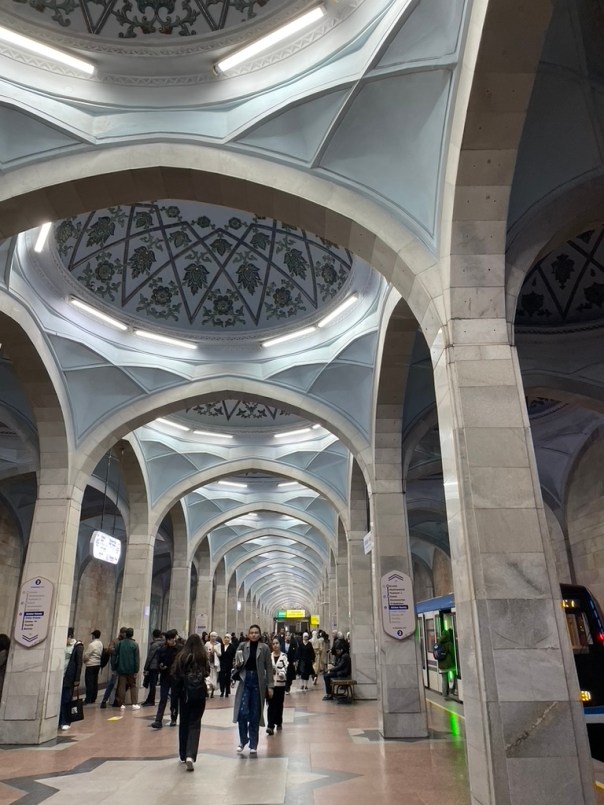
On our return to Tashkent, Lars had everything sussed out after completing some research including the metro system. His fellow Norwegian compatriot Emily, an undertaker by profession, were setting off for the day, so myself and some other Europeans stuck close by knowing that we didn’t need to spend half our day trying to find a translator or figure out the transport system.  We went back to Chorsu Bazaar where some of the group set about finding silk scarves to bring home as gifts. I picked up some saffron and dried fruits for gifts and our next stop was to a leather shop two stops on the metro, well researched by the fabulous Lars. Kanishka was like an Aladdin’s cave of quality goods including belts, jackets, bags, key fobs, passport covers all with creative and unique designs.  The metro, like the rail system was built by the Russians and really cheap and efficient. Some of the stations were just stunning, the most interesting being the station celebrating, Kosmonavtlar (Cosmonauts), is a space-programme-themed station, part of the Tashkent Metro. The murals on the station walls celebrate Soviet cosmonauts such as Yuri Gagarin and Valentina Tereshkova, the first man and woman in space.

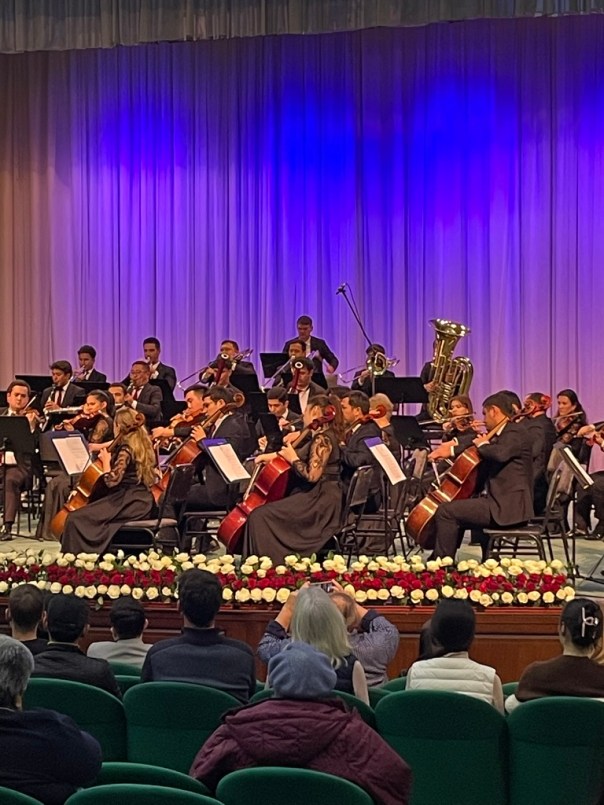
The Uzbek National Symphony Orchestra.

After the election debriefing and before dinner on our last evening we managed to make it to a recital of the Uzbekistan National Symphony Orchestra with performances by two female soloists, a cellist and violinist. For the princely sum of about €7.50 we were treated to 90 minutes of pure joy. Unlike most Western cultural orchestral events, the audience was made up of ordinary working class citizens, some on the way home from work, others were mothers who brought their children along and of course students of the school of music where the event was held.

I knew little about Uzbekistan before the assignment, although when I told friends, I heard of several people who recently made it there on vacation. While Uzbekistan is a largely Muslim country, its government is secular and there are few restrictions for women’s dress, more obvious in other more strict Islamic countries such as Afghanistan and Iran. Dress is conservative, but the hijab is not compulsory, and many women choose to leave their hair uncovered.  There is no apparent evidence of extremism in the country or exploitation of minorities, although setting up an opposition political party could prove problematic.

Uzibekistan has its share of challenges like most other countries. We asked our driver to bring us through the industrial area where he worked. Kilometre after kilometre all we could see was enormous Chinese factories, without much evidence of respect for the environment. I guess in a developing nation, providing employment for its citizens would be a priority and diffcult to turn down the lure of Chinese investment.

My visit to Uzbekistan was such a pleasantly surprising trip and I would highly recommend a visit while it is still realtively undiscovered as a tourist destination. You will be treated to great food, high culture and a genuinely friendly and welcoming people.

Author’s note: No part of this blog was produced by AI, which I believe, removes the human imagination. I’m happy to report that all the errors are mine and mine alone.

Uzbekistan Facts:  Uzbekistan was part of the Soviet Union until the block fell in 1991 and it gained independence.  A poor country at the time, Uzbekistan is now considered middle-income and is ranked 106 of 193 countries on the United Nations Human Development Index. A resource rich land, Uzbekistan has natural gas, oil, copper, lead, zinc, tungsten, uranium and has the 4th largest gold deposits in the world.  Water is a scarce resource as a result of overproduction in cotton farming. Cotton, of course, uses enormous quantities of water and has left large swathes of land arid and facing increasing desertification. Uzbekistan is dependent on neighbouring countries for a huge share of the water it consumes and the cause of some tension among its neighbours[1].  

Uzbekistan was once part of the famous Silk Road that ran from China where a network of trade routes connecting China and the Far East with the Middle East and Europe was created. Established with the West in 130 B.C., the Silk Road routes remained in use until A.D. 1453, when the Ottoman Empire boycotted trade with China and closed the routes. Although it’s been nearly 600 years since the Silk Road was used for international trade, the routes had a lasting impact on commerce, culture and history that resonates today[2].  


[1] https://thediplomat.com/2019/09/uzbekistans-impending-water-crisis/

[2] https://www.history.com/topics/ancient-middle-east/silk-road